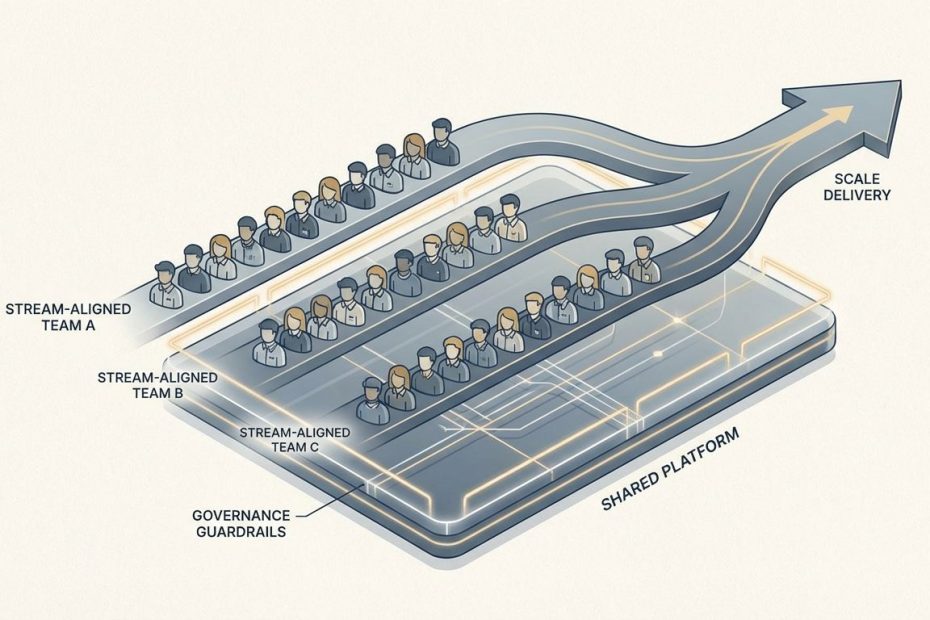
A federated team model scales delivery by keeping day-to-day ownership inside domain, product, stream-aligned teams, while a small set of central functions provide guardrails, reusable platforms, and lightweight decision systems. You keep autonomy where speed matters, and you centralize only what must stay consistent.
You can use this article to decide whether federation fits your organization, design the operating model so it doesn’t collapse into chaos, and set platform team responsibilities that reduce friction instead of adding a new gate. You also get a set of practical measures, interaction patterns, and rollout moves that help you shift from “org chart delivery” to “value-stream delivery” without stalling critical work.
What Is A “Federated Team” Model In Software Delivery?
In a federated delivery model, product-aligned teams own delivery outcomes end to end, including build, run, and continuous improvement, and they do it inside centrally defined constraints. Those constraints exist to protect enterprise concerns like reliability, security, and interoperability, without forcing every decision through a single approvals queue.
The defining trait is local autonomy plus central alignment. You distribute capacity to where demand exists, then you prevent fragmentation using shared platforms, shared standards, and a clear “who decides what” map. If federation is implemented well, domain teams do not wait for a central team to deliver work, and central functions do not get pulled into bespoke, team-by-team firefighting.
Federation also changes how architecture and governance behave. Instead of architecture operating as an isolated review layer, it becomes a capability that sits closer to delivery and gets expressed as paved roads, reference implementations, reusable components, and automated controls. When federation works, you notice fewer “permission slips,” fewer handoffs, and fewer meetings that exist only to negotiate ownership.
Federated Vs Centralized Delivery: Which Scales Better, And What Breaks First?
Centralized delivery scales until it becomes the waiting room for every request. A single team can concentrate expertise, standardize quickly, and coordinate decisions, but demand growth turns that central group into the throughput limiter. When the intake grows, you see longer lead times, more escalation, and a steady shift from engineering work to queue management.
Federated delivery scales capacity by shifting ownership to domain teams, then using platform and enablement capabilities to keep quality consistent. You gain parallelism, but you also pay a “federation tax”: more teams making more decisions means inconsistency appears unless the guardrails are explicit, measurable, and easy to follow.
What breaks first in federation is rarely code quality. It is ownership clarity, funding alignment, inconsistent execution, and governance that stays manual. If teams need tickets to get safe defaults, or if standards exist only in documents, variation becomes the default state. Microsoft’s guidance on delivery models calls out bottlenecks and reduced agility as common centralized risks, which is exactly the pressure that pushes organizations toward decentralization and federation when demand outgrows a central group.
How Do Team Topologies Map To Federated Teams (Stream-Aligned, Platform, Enabling)?
Federation becomes far easier to operate when you align it with the Team Topologies model. You treat delivery teams as stream-aligned teams with clear boundaries and stable ownership, then you keep their cognitive load under control by investing in platform teams and enabling teams that remove friction and transfer capability.
Team Topologies defines four team types, stream-aligned, enabling, complicated-subsystem, and platform, and three interaction modes, collaboration, X-as-a-service, facilitation. Those constructs are useful in federation because they force you to define how teams interact, instead of letting interaction default to meetings, informal favors, and “please help” escalations.
Once those interaction modes are explicit, you can reduce two chronic federation failures: hidden dependencies and unclear service expectations. A platform team can expose capabilities as a service with published interfaces, an enabling team can coach teams through adoption without owning the work forever, and stream-aligned teams can keep flow moving without dragging specialists into constant ad hoc support.
What Governance And Guardrails Do Federated Teams Need To Avoid Chaos?
Federated governance must be automated, self-service, and enforceable without relying on people as the control mechanism. When governance depends on committees, inbox approvals, or “someone remembers to review it,” you get delay, inconsistent enforcement, and predictable workarounds.
Start by defining guardrails that protect the enterprise while preserving team autonomy: identity and access patterns, environment controls, deployment and release requirements, logging and monitoring standards, incident response expectations, data handling rules, and dependency management conventions. Then encode those rules into templates, pipelines, policy-as-code, reference architectures, and service catalog entries, so teams comply by default.
Also define what is centrally owned vs locally owned. Keep central ownership focused on shared runtime platforms, cross-cutting risk controls, and enterprise-wide integrations that must remain uniform. Keep local ownership on product delivery decisions, local service design, and domain-specific tradeoffs, with clear escalation paths only when a decision crosses a defined risk threshold.
What Should A Platform Team Do In A Federated Model, And What Should It Not Do?
Your platform team exists to ship an internal product that improves delivery throughput for stream-aligned teams. The output is not a slide deck, an architecture review committee, or a pile of “recommended tools.” The output is a set of paved roads: opinionated, supported ways to build, deploy, observe, and operate services with low effort and predictable outcomes.
Platform work that pays off in federation includes standardized CI/CD building blocks, golden-path templates, secure defaults, self-service environment provisioning, service discovery, runtime tooling, observability, and reliability automation. Those capabilities reduce duplicate work across teams and keep the organization from funding ten versions of the same solution.
What the platform team must not do is become the central delivery team wearing a new name. If the platform team owns every exception, builds bespoke pipelines per team, or gates releases with manual approvals, federation collapses back into centralization. Community discussions around platform teams repeatedly flag “reinventing the wheel” and unclear boundaries as recurring pain points, and those signals matter: if teams cannot tell where the platform ends and product work begins, accountability gets blurry and delivery slows.
What Are The Most Common Failure Modes Of Federated Delivery (According To Practitioners)?
The most common failure mode is shipping federation as a re-org rather than as a product and operating model change. If ownership moves to domain teams but the tools, access, environments, and support model remain ticket-driven, teams inherit responsibility without the ability to execute it. That creates frustration, uneven quality, and a fast return to escalations.
The second failure mode is under-specifying interfaces. Teams then compensate by building local standards, local tooling, local workarounds, and local pipelines. You get a “company of many companies,” which looks busy and feels autonomous, but increases total cost and decreases reliability because each local variation becomes a new operational surface area.
The third failure mode is platform drift. A platform team can either become too controlling, enforcing sweeping patterns that reduce productivity, or too detached, building tooling nobody asked for. Practitioner threads about platform engineering often stress that a platform must solve real problems for product teams, not platform-team ideas that read well on a roadmap.
What Is Federated Delivery?
- Federated delivery = domain teams ship and run products
- Central teams provide guardrails, platforms, enablement
- Autonomy stays high, risk stays controlled
Turn Federation Into Execution
If delivery demand is outgrowing a central team, federation gives a scalable path by distributing ownership to stream-aligned teams and centralizing only the capabilities that must stay consistent. Platform and enabling teams keep cognitive load manageable, reduce duplication, and keep governance enforceable without turning into a gate. Success comes from clarity: clear boundaries, clear interaction modes, measurable guardrails, and internal platform products that teams choose because they work. Implement it with intent, measure flow and reliability, and treat the platform like any other product with users, feedback loops, and service-level expectations.
References
- Team Topologies: Key Concepts
- IT Revolution: The Four Team Types From Team Topologies
- Microsoft Learn: Evaluate Delivery Models (Power Platform)
- Forrester Blog: Federated Delivery
- McKinsey: Crafting The Optimal Model For The IT Architecture Organization
- Reddit: Platform Team Experiences Thread
- Reddit: Platform Engineering Discussion

Jay Holstine is a Vistage Chair and veteran tech CEO with 20+ years of experience in SaaS and operations. The founder of SigmaFlow and former CEO of Freightflow, he now leads a Dallas–Fort Worth CEO peer group and advises executives on strategy, process improvement, and scalable growth.